Spark plug replacement - when, how, and cost
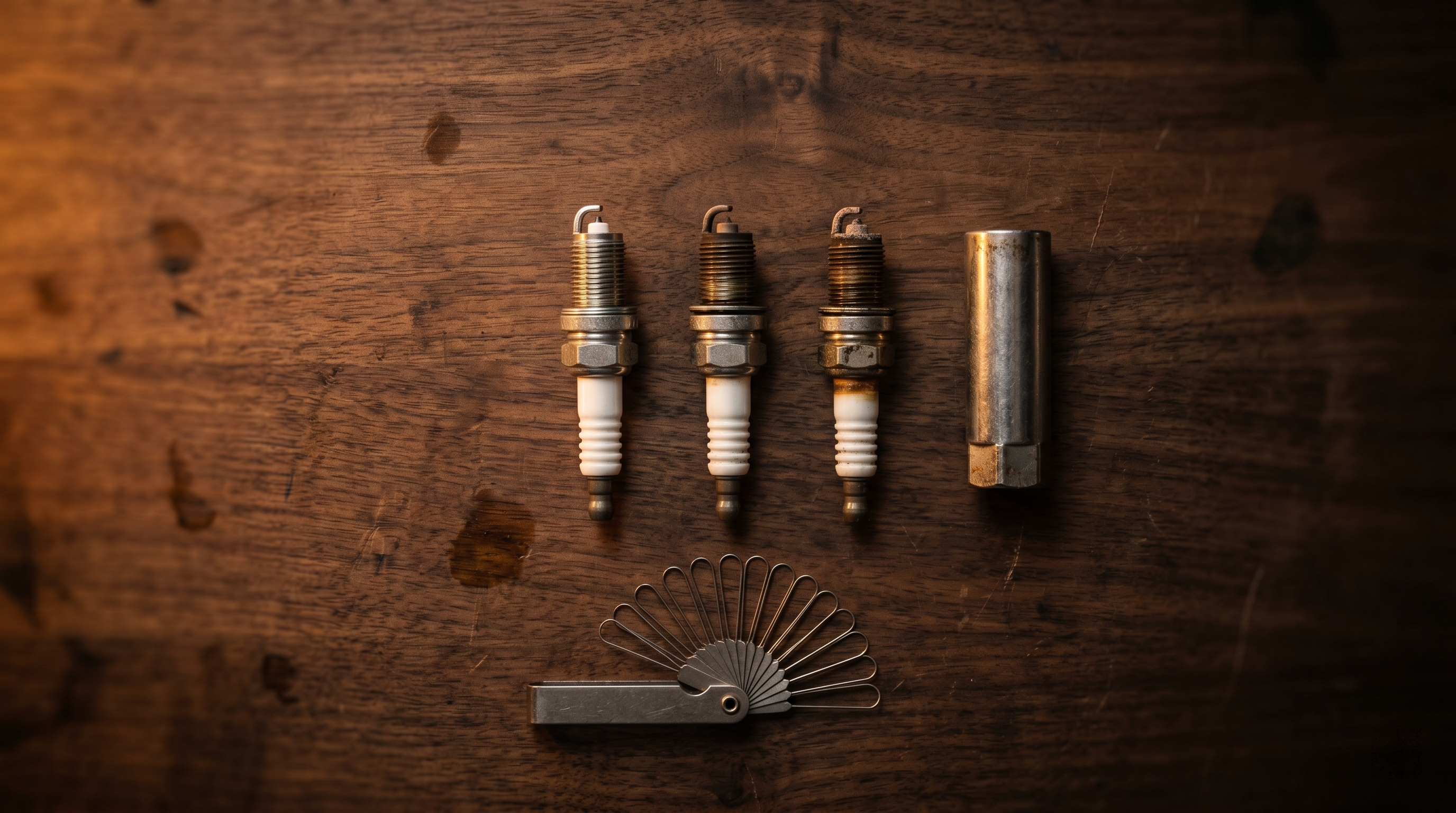
Most spark plugs on modern cars last 80,000–100,000 miles before they need replacement. If your car was built after 2010, it almost certainly left the factory with iridium plugs, not the copper-core plugs that wore out every 30,000 miles in the 1990s. The 2024 Toyota Camry 2.5L, for instance, doesn't call for new plugs until 120,000 miles per Toyota's published maintenance schedule. Replacing plugs at 30,000 miles based on outdated advice wastes $150–$400 on parts and labor for zero benefit.
How Often Should You Replace Spark Plugs?
Replacement intervals depend on the electrode material. Copper-core plugs (like the NGK V-Power series) wear out in 20,000–30,000 miles because the nickel alloy electrode erodes quickly under combustion heat. Single platinum plugs stretch to about 60,000 miles. Double platinum plugs, required in waste-spark ignition systems where both electrodes fire, last 80,000–100,000 miles. Iridium is the current standard: NGK's Iridium IX line covers 60,000–80,000 miles, while their Laser Iridium plugs (which pair an iridium center electrode with a platinum-tipped ground electrode) reach 80,000–120,000 miles.
These numbers shift by manufacturer and engine. Toyota specifies 120,000 miles for the Camry 2.5L four-cylinder but only 60,000 miles for the Camry 3.5L V6, per Toyota's published maintenance schedule. Honda's Maintenance Minder system flags spark plugs at roughly 60,000 miles for the Civic 1.5T. Ford lists 100,000 miles for the F-150 3.5L EcoBoost, except trucks with Pro Power Onboard (the bed-mounted generator), which get a shorter 60,000-mile interval because extended idling in generator mode accelerates electrode wear.
Follow the interval in your owner's manual, not generic advice. A 2024 Camry 2.5L uses different plugs with a different interval than a Camry 3.5L V6: same car, different schedules. Your owner's manual or your dealership's parts counter can confirm the OEM part number and interval for your specific engine. Pinion pulls your manufacturer's spark plug replacement schedule using your VIN and sends a reminder when your mileage approaches the due date.
Copper vs. Platinum vs. Iridium Spark Plugs
The practical difference between plug types comes down to electrode material, how thin the center electrode can be manufactured, and how long it lasts before the gap widens past spec. Iridium melts at 4,471°F compared to 3,215°F for platinum and 2,651°F for nickel. That thermal resistance lets manufacturers build a center electrode as narrow as 0.4mm, versus 2.5mm on a copper-core plug. A thinner electrode concentrates the spark, requires less voltage to fire, and resists erosion across more miles.
| Plug Type | Electrode Material | Lifespan | Cost Per Plug | Typical Application |
|---|---|---|---|---|
| Copper/Nickel (NGK V-Power) | Copper core, nickel alloy | 20,000–30,000 mi | $2–$5 | Pre-2005 vehicles, select high-performance engines |
| Single Platinum (NGK G-Power) | Platinum center electrode | ~60,000 mi | $4–$8 | 2000–2012 vehicles |
| Double Platinum | Platinum center and ground | 80,000–100,000 mi | $6–$10 | Waste-spark ignition systems |
| Iridium (NGK Iridium IX) | Iridium center, nickel ground | 60,000–80,000 mi | $8–$15 | 2010+ vehicles |
| Laser Iridium (NGK Laser Iridium) | Iridium center, platinum ground | 80,000–120,000 mi | $8–$15 | 2015+ OEM replacement spec |
Source: NGK spark plug metal types guide
Always match or exceed the plug type your engine came with from the factory. A 2022 Honda Civic 1.5T uses OEM plug 12290-5PA-A01 (cross-referenced as NGK ILZKAR8J8SY, a Laser Iridium plug). Replacing it with a $3 copper plug means changing plugs 4x as frequently and losing combustion efficiency. Going the other direction, upgrading from the OEM iridium to a higher-tier iridium, offers minimal benefit on a stock engine. The factory plug was engineered for that combustion chamber.
The gap between NGK Iridium IX and Laser Iridium matters more than most sources mention. Iridium IX plugs use a nickel ground electrode that wears faster, giving them a 60,000–80,000 mile lifespan. Laser Iridium plugs add a platinum tip to the ground electrode, extending life to 80,000–120,000 miles. Both cost $8–$15 per plug. Check whether your OEM spec calls for the longer-life Laser Iridium variant, which is common on 2015+ vehicles.
Signs You Need New Spark Plugs
A worn spark plug misfires because the eroded electrode can't produce a consistent spark across the widened gap. The clearest symptoms: a rough or uneven idle, hesitation during acceleration, a measurable drop in fuel economy (3–10% is typical with worn plugs), and hard starts in cold weather. A single misfiring cylinder triggers diagnostic trouble codes P0300 (random/multiple misfire) through P0308 (cylinder 8 misfire) and illuminates the check engine light.
These symptoms warrant inspection even if you haven't reached the scheduled replacement mileage. Conditions that accelerate plug wear include frequent short trips where the engine never fully warms up, regular towing or hauling heavy loads, turbocharged engines running at higher combustion pressures, and oil burning past worn valve seals (which deposits carbon on the plug electrode). An OBD2 scanner that reads live misfire counts per cylinder helps distinguish worn plugs from failing ignition coils or clogged fuel injectors, and a $30 scan tool eliminates guesswork.
Don't ignore misfires. A misfiring cylinder dumps unburned fuel into the catalytic converter, which can overheat and fail, a repair that runs $1,000–$2,500 on most vehicles. If your check engine light is flashing (not steady), that signals active misfires severe enough to damage the converter. Pull over and get the codes read before a $40 spark plug job turns into a $2,000 catalytic converter replacement.
How Much Does Spark Plug Replacement Cost?
At an independent shop, spark plug replacement runs $100–$500 depending on engine type. The biggest cost variable isn't the plugs (a set of 4 NGK Laser Iridium plugs costs $32–$60) but the labor required to access them. AAA's repair cost data and RepairPal's 2026 estimator break down as follows:
| Engine Type | Independent Shop | Dealership | DIY (Parts Only) |
|---|---|---|---|
| 4-cylinder | $100–$250 | $200–$350 | $16–$60 |
| V6 | $150–$350 | $250–$450 | $24–$90 |
| V8 | $200–$500+ | $300–$600+ | $32–$120 |
Sources: AAA average spark plug replacement cost; RepairPal 2026 estimator
RepairPal's vehicle-specific estimates show how access difficulty affects the price. A Toyota Corolla (inline-4, easy access) runs $182–$261. A Ford Explorer (V6, moderate access) costs $208–$293. A Chevrolet Silverado 1500 (V8, eight plugs, tighter clearances) hits $335–$452. Labor is the primary cost driver, since plugs themselves run $4–$15 each, but shops charge 1–3 hours at $80–$150/hour depending on engine complexity.
For a 2024 Toyota Camry 2.5L, DIY spark plug replacement costs about $40: four NGK Laser Iridium plugs (OEM part 90919-01289) at roughly $10 each. The same job at a dealership runs $200–$350. If you own a spark plug socket and torque wrench, the 30-minute DIY saves you $160–$310 in labor. Even buying the tools from scratch ($40–$60 for a socket set and torque wrench), you break even on the first job and save on every one after.
How to Replace Spark Plugs Yourself
On most 4-cylinder engines with coil-on-plug ignition, spark plug replacement takes 30–60 minutes with basic hand tools. V6 engines with transverse mounting (front-wheel-drive layouts like the Toyota Camry V6 with the 2GR-FE) take 2–3 hours because the rear-bank plugs sit against the firewall, and certain models require intake manifold removal to access them. If your engine needs the manifold pulled, factor in a new intake gasket ($15–$30) and consider whether the labor savings justify the added complexity.
Tools
- 3/8-inch ratchet
- Spark plug socket, 5/8-inch (16mm) for most 14mm-thread plugs; verify for your vehicle
- 6-inch and 10-inch extension bars
- Torque wrench (ft-lbs range)
- Feeler gauge
- Compressed air or shop vacuum
- Dielectric grease
Step by Step
Work one cylinder at a time. This prevents mixing up coil connections and keeps open spark plug wells to a minimum.
1. Disconnect and remove the ignition coil. Press the release tab on the electrical connector and unplug it. Remove the 10mm bolt (8mm on certain engines) holding the coil pack. Pull the coil straight up and out of the well.
2. Blow out the spark plug well. Use compressed air to clear debris around the plug base. Dirt that falls into the cylinder during removal can score the cylinder wall or embed in the piston crown.
3. Remove the old plug. Insert the spark plug socket (the rubber insert grips the plug ceramic) and turn counterclockwise to break it loose. Once free, unthread by hand.
4. Check the gap on the new plug. Most iridium plugs come pre-gapped from the factory, but verify with a feeler gauge against your service manual spec. The 2024 Camry 2.5L calls for 0.043 inches (1.1mm). If the gap needs adjustment, bend only the ground electrode, and never force the center electrode.
5. Install the new plug by hand. Drop the plug into the socket and lower it into the well. Thread clockwise by hand for the first three or four turns. Any resistance means stop, since cross-threading a plug into an aluminum cylinder head costs $300–$1,000 to repair with a thread insert. Once finger-tight, torque to spec: 18–22 ft-lbs for 14mm-thread plugs, 11–15 ft-lbs for 12mm-thread plugs.
6. Apply dielectric grease and reinstall the coil. A thin film of dielectric grease inside the coil boot seals out moisture and eases future removal. Seat the coil firmly, reinstall the bolt, and reconnect the electrical connector with a click.
7. Start the engine and verify. After completing all cylinders, start the engine and listen for a smooth, even idle. A misfire after installation usually means a loose coil connector or a plug that isn't fully seated, so recheck that cylinder.
Do not apply anti-seize compound to spark plugs unless your service manual specifically calls for it. NGK and Denso design their plugs with a trivalent zinc-chromate shell plating that prevents seizing. Anti-seize lowers thread friction, which means the same torque wrench setting over-tightens the plug, potentially by 20–30%, and risks stripping the aluminum threads in the cylinder head. For engines with a history of plug seizure (Ford 3.5L EcoBoost, for example), apply penetrating oil to the plug base and let it soak for 30 minutes before removal instead.
Common Mistakes
Skipping the torque wrench. Over-tightened plugs strip the aluminum threads in the cylinder head — a repair that runs $300–$1,000 with a Heli-Coil or Time-Sert thread insert. Under-tightened plugs can vibrate loose or fail to seal combustion gases. Torque to spec every time.
Forcing a stuck plug. On turbocharged engines like the Ford 3.5L EcoBoost (Motorcraft SP-596 for 2022+ models, SP-594 for 2017–2021), plugs left in past their interval can bond to the aluminum head. Forcing removal breaks the ceramic insulator, leaving the metal shell stuck in the head and requiring a special extraction tool. Penetrating oil and patience cost nothing. Extraction adds $200+ to the job.
Using the wrong socket. Spark plug sockets have a rubber insert that grips the ceramic insulator. A standard deep socket lacks this insert and risks cracking the insulator or dropping the plug into the engine bay.
Spark plug replacement is one item in your engine's broader service schedule. If plugs are due, check whether your timing belt or air filter is also due at the same mileage — bundling services at one shop visit saves a second trip. Your vehicle's complete maintenance schedule lists everything due at each interval.
Frequently Asked Questions
Vlad Kuzin
Developer of Pinion. Writes about car maintenance to help people save money and stay safe on the road.