Best OBD2 Scanners for DIY Car Diagnostics (2026)
A $20 Bluetooth ELM327 adapter paired with a $5–$10 phone app reads and clears the same check engine codes as a $300 shop scanner. The OBD-II protocol is identical; only the packaging differs. For most home mechanics, the right combination is a BAFX Products adapter for Android or a Veepeak OBDCheck BLE+ for iPhone running Torque Pro or OBD Fusion. You only need to spend $150 or more if you want bi-directional control (cycling fuel pumps, bleeding ABS, resetting electronic parking brakes), live data graphing across multiple PIDs, or manufacturer-specific codes for BMW, Mercedes, VW, or Ford modules.
The Honest Take on OBD2 Scanners
The OBD-II standard is federal law, and every compliant vehicle reports the same generic powertrain data the same way. A $20 Bluetooth dongle and a $2,000 Snap-on Solus return identical Mode 01–09 information for the engine and emissions system. Per SAE J1979, every OBD-II-compliant car must support a defined set of PIDs (Parameter IDs) for engine speed, coolant temp, fuel trim, oxygen sensor voltage, freeze frame, and stored/pending DTCs. The expensive scanner adds manufacturer-specific code databases, factory bi-directional tests, and a built-in screen; none of which a home mechanic needs to figure out why a check engine light came on.
The single decision that matters for 90% of buyers is Android vs. iPhone, because that determines the Bluetooth protocol the adapter must use. Android works with classic Bluetooth ELM327 clones (cheaper, more options); iPhone requires Bluetooth Low Energy (BLE) adapters, which cost slightly more and have a narrower selection. After that, the apps do the work.
For a home mechanic, the right OBD2 scanner is a $15–$25 Bluetooth ELM327 adapter plus a $5–$10 phone app. The BAFX Products adapter ($22) covers Android; the Veepeak OBDCheck BLE+ ($30) covers iPhone. Pair either with Torque Pro ($4.99, Android) or OBD Fusion ($9.99, iOS/Android) and you have a tool that reads/clears codes, shows live engine data, captures freeze frames, and runs OBD-II readiness monitors. Total cost under $35. Spend more only if you need ABS/airbag/transmission codes or bi-directional control.
What an OBD2 Scanner Actually Does
An OBD2 scanner talks to your vehicle's powertrain control module (PCM) over the 16-pin OBD-II port and asks for diagnostic information defined in the SAE J1979 standard. It does five practical things: read stored diagnostic trouble codes (DTCs), clear codes, display live sensor data (RPM, coolant temp, fuel trim, oxygen sensor voltage, MAF airflow), capture freeze frame data (a snapshot of all live values at the moment a code set), and run OBD-II readiness monitors required to pass state emissions inspections.
Generic OBD-II covers nine standard modes. Mode 01 reads current sensor values; Mode 02 reads freeze frame data; Mode 03 returns stored DTCs; Mode 04 clears codes and resets monitors; Mode 09 returns the VIN and calibration ID. Higher-tier scanners go beyond the OBD-II standard and access manufacturer-specific networks, such as the Ford MS-CAN bus that carries body and chassis modules, or the BMW-FAST protocol on K-CAN/PT-CAN that handles iDrive, lighting, and SRS data. Generic ELM327 chips cannot reach those networks reliably.
The diagnostic port itself is standardized by SAE J1962: the same 16-pin connector, the same pin assignments, the same location requirement (within two feet of the steering wheel) on every U.S. vehicle sold since 1996 for gasoline and 1997 for light-duty diesel. The EPA confirms OBD-II became mandatory on 1996 model-year vehicles to enforce Clean Air Act emissions standards. If a code reader fits one car, the physical connection fits them all.
Bluetooth Dongles vs. Handheld Scanners vs. Pro Tools
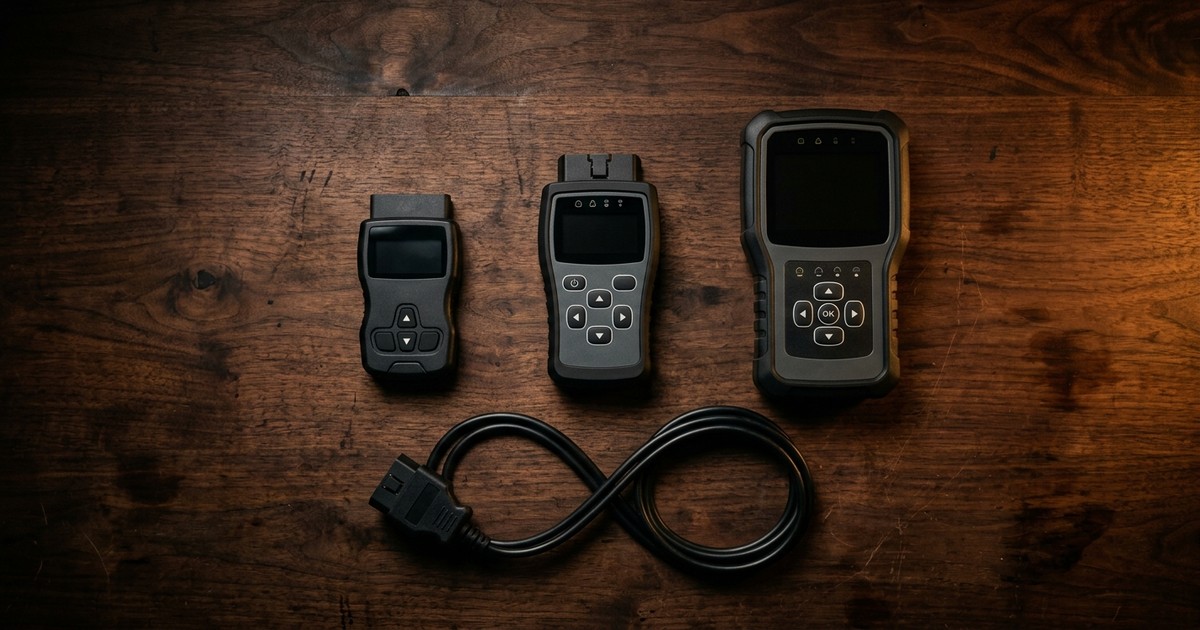
Bluetooth dongles win on price and flexibility for home use; dedicated handheld scanners win on instant boot time and self-contained operation; professional tools justify their cost only when you're billing labor. A $22 BAFX adapter and Torque Pro run circles around a $40 handheld code reader for live data because your phone's screen graphs multiple PIDs simultaneously and stores logs. A $30 wired handheld like the Autel AutoLink AL319 is faster for a quick code-pull in someone else's driveway because there's no pairing step.
| Tier | Price (2026) | Examples | Reads | Clears | Live Data | Mfr Codes | Bi-Directional |
|---|---|---|---|---|---|---|---|
| Bluetooth ELM327 (Android) | $15–$25 | BAFX Products, Vgate iCar Pro | Yes | Yes | Yes (via app) | Select (FORScan, BimmerLink) | No |
| Bluetooth BLE (iPhone) | $25–$30 | Veepeak OBDCheck BLE+, Vgate iCar Pro BLE | Yes | Yes | Yes (via app) | Limited | No |
| Pro Bluetooth | $100–$140 | OBDLink MX+, BlueDriver Pro | Yes | Yes | Yes (multi-PID graphs) | Yes (ABS, SRS, TCM) | Limited |
| Entry handheld | $30–$60 | Autel AL319, Innova 3100j | Yes | Yes | Basic | No | No |
| Mid handheld | $80–$200 | Innova 5610, Foxwell NT301, Ancel BD310 | Yes | Yes | Yes (graphs) | Partial | Limited |
| Bidirectional pro | $300–$700 | Autel MaxiCOM MK808, Launch CRP909X, Foxwell NT530 | Yes | Yes | Yes | Yes | Yes |
| Shop-level pro | $1,500–$10,000 | Autel MaxiSys MS909, Snap-on Solus Edge, Bosch ADS 625 | Yes | Yes | Yes | Yes (factory level) | Full (incl. coding) |
The BAFX Products Bluetooth OBD-II adapter has held a 4.3-star Amazon rating across more than 80,000 reviews and remains the de facto Android budget pick. Veepeak's OBDCheck BLE+ is the iPhone equivalent because it uses Bluetooth Low Energy, the only Bluetooth flavor iOS allows third-party hardware to use without an MFi license. If a BLE adapter is sold "for iPhone" without the BLE label, check for "Bluetooth 4.0" or higher in the listing before buying.
Best OBD2 Scanner Apps
The right phone app turns a $20 dongle into a more capable diagnostic tool than most $100 handhelds. Three apps cover almost every use case. Torque Pro ($4.99 on Google Play) is the Android standard: it supports custom PIDs, plugin extensions for transmission and ABS data on supported makes, and exports logs as CSV. OBD Fusion ($9.99 on iOS and Android, by OCTech) is the iOS standard with a cleaner UI and built-in CAN bus support. Car Scanner ELM OBD2 is free on both platforms with in-app purchases for manufacturer-enhanced data on Ford, GM, Toyota/Lexus, and Renault/Nissan.
For brand-specific work, FORScan + Lite ($3.99 on iOS, $4.99 on Android) is the gold standard for Ford, Lincoln, and Mazda. It programs body modules, enables auto-start-stop disable, and reads every CAN module on the truck. BimmerLink ($29.99) and Bimmercode ($29.99) handle BMW and Mini code reads, service resets, and module coding when paired with an OBDLink MX+ adapter. Carly ($79.99/year subscription plus a $60 adapter) is the best all-in-one app for German cars, covering BMW, Mercedes, Audi, VW, Porsche, and Mini with a polished interface.
For Android, install Torque Pro ($4.99) plus the free Torque ELM327 plugin. For iPhone, install OBD Fusion ($9.99). Both apps display real-time RPM, coolant temperature, fuel trim, mass airflow, and oxygen sensor voltage; both read and clear stored, pending, and permanent DTCs; both run OBD-II readiness monitors. For Ford or Mazda, add FORScan. For BMW, add Bimmercode and switch the adapter to an OBDLink MX+.
When You Actually Need a $150+ Scanner
Spend more than $150 only if you fall into one of four buckets: you want bi-directional control, you want manufacturer-specific codes outside generic OBD-II, you want native ABS/SRS/TCM access without third-party apps, or you bill for diagnostic work. Every other reason is upsell. The $20 Bluetooth dongle reads the same powertrain DTCs and the same emissions monitors that a $400 Autel MaxiCOM reads.
Bi-directional control sends commands from the scanner back to the vehicle: cycling the EVAP purge solenoid, activating the cooling fans, bleeding the ABS pump, retracting the electronic parking brake to service rear pads, performing a throttle body relearn after cleaning. Without it, you can only read what the car is doing. With it, you can make the car do things to confirm a diagnosis. Three options cover this for a home mechanic: the OBDLink MX+ ($140) with BimmerLink for BMW, the BlueDriver Pro ($120) which adds ABS/SRS/TCM reads on most makes, and the Autel MaxiCOM MK808 ($349) for full bi-directional control across roughly 80 brands.
You need a $150+ scanner only if you fall into one of four buckets: bi-directional control (cycling fuel pumps, bleeding ABS, retracting EPB pistons), manufacturer-specific codes beyond P0xxx, native ABS/SRS/TCM access without third-party apps, or you bill for diagnostic time. The BlueDriver Pro ($120) is the cheapest tool that adds ABS/SRS/TCM reads on most makes. The Autel MaxiCOM MK808 ($349) is the cheapest tool with full bi-directional control across about 80 brands. Everything between $50 and $100 in handheld code readers duplicates what the $22 Bluetooth dongle already does.
The Foxwell NT530 ($219 plus $60 per additional brand software) is the value pick for brand-specific work. Buy it with one software (BMW, Mercedes, Toyota, GM, Ford, Honda, etc.) and you get the same enhanced data your dealership scanner reads: service resets, ABS bleeds, and transmission adaptations, without a subscription. The Launch CRP129E ($179) handles four-system diagnostics (engine, transmission, ABS, SRS) with oil reset, EPB reset, throttle adaptation, and SAS calibration built in.
If you already have a check engine light triggered, our check engine light guide walks through what each code category means and which need urgent attention. For broader troubleshooting beyond OBD-II, the car diagnostic guide covers visual inspection, smoke testing, and pinpoint electrical testing the scanner can't do.
OBD2 Scanners for Specific Brands
Brand-specific networks are why generic ELM327 dongles hit a ceiling around the powertrain module. Every automaker layers proprietary CAN buses on top of OBD-II for body, chassis, infotainment, and ADAS modules. Reading those requires the right combination of adapter chip and app.
BMW and Mini. Pair an OBDLink MX+ ($140) with Bimmercode for module coding or BimmerLink ($29.99) for service resets, battery registration after a car battery replacement, and oil service interval resets. Generic clones cannot read BMW's BMW-FAST protocol on the K-CAN/PT-CAN networks where the iDrive head unit, lighting modules, and SRS controllers live.
Ford, Lincoln, Mazda. Pair a Vgate iCar Pro Bluetooth 4.0 adapter ($30) with FORScan + Lite ($3.99 on iOS, $4.99 on Android). FORScan accesses Ford's MS-CAN bus where body modules, the SYNC unit, and the 4WD transfer case live. It's also the only home-friendly way to enable or disable features like double-honk lock confirmation, auto-start-stop default, and global windows.
VW, Audi, Skoda, SEAT. The reference tool is Ross-Tech VCDS ($229 for the HEX-NET wireless version), which gives factory-level access to every module on a VW Group car. For lower-cost coding, OBDeleven ($30 adapter plus app credits) covers MQB-platform cars (Mk7+ Golf, Mk3 Audi A3, etc.).
Toyota, Lexus. Generic OBD2 works for powertrain codes. For hybrid battery state-of-health on a Prius or Camry Hybrid, Dr. Prius / Dr. Hybrid (free with in-app purchase, ~$15 for the full feature set) plus a Vgate iCar Pro BLE adapter reads battery block voltages, internal resistance, and individual cell health that no generic scanner exposes.
Mercedes-Benz. iCarsoft MB II ($240) is the standalone handheld pick. Carly + Carly adapter ($60 hardware + $80/year subscription) is the smartphone alternative, covering coding for the SAM modules, EZS ignition, and ME engine controller.
Honda, Acura. Honda HDS clones are available but legally questionable; the cleaner path is the Foxwell NT530 with Honda software ($279 bundle) or a Bluetooth dongle plus Car Scanner with the Honda enhanced data add-on ($10).
How to Use an OBD2 Scanner
Reading codes with a Bluetooth scanner takes about five minutes and requires no mechanical skill. The OBD-II port is in roughly the same location on every car: within two feet of the steering wheel, under the dash, above the pedals or behind a small panel. Plug in the adapter, pair with your phone, turn the ignition to On (not Start), open the app, and tap Read Codes. The full procedure is in the HowTo block in this article's metadata, but two practical details get missed every time.
First, do not clear codes before you write them down, including pending codes. A pending code is a fault the OBD-II monitors have detected once but not yet enough times to set a stored DTC. It is the early warning. Scanners and apps default to only reading stored codes; flip the toggle to show pending codes and you will see what is developing.
Second, do not clear codes right before a state emissions test. Clearing DTCs also clears OBD-II readiness monitors (catalyst, EVAP, EGR, oxygen sensor, oxygen sensor heater, secondary air system, A/C system). State inspection programs require most monitors to read Ready before they'll certify the vehicle. The monitors typically reset over 50–200 miles of mixed highway and city driving; the EVAP monitor can take longer because it requires a specific fuel level and cold-start temperature window.
Pinion's app includes an OBD2 diagnostic code reference so you can look up any P, B, C, or U code without leaving the maintenance log. It does not act as a scanner; it is a code lookup for codes you have already pulled.
OBD2 Scanner Cost vs. Use-Case
The right scanner depends entirely on what you intend to do with it. The table below maps common home-mechanic tasks to the minimum tool that handles them.
| Use Case | Minimum Tool | Cost (2026) | Notes |
|---|---|---|---|
| Check why CEL is on, clear code after gas cap fix | BAFX Bluetooth + Torque Pro | $27 | Reads P0xxx generic codes |
| Track fuel trim, MPG, live sensor data | Any ELM327 + OBD Fusion | $35 | Logs to CSV for analysis |
| Confirm OBD-II readiness for state inspection | Any ELM327 + Car Scanner (free) | $20 | Shows all monitor statuses |
| Read ABS, SRS, transmission codes (most makes) | BlueDriver Pro | $120 | No app subscription |
| Reset oil service interval on BMW | OBDLink MX+ + BimmerLink | $170 | Also handles battery registration |
| Enable hidden features on Ford F-150 | Vgate iCar Pro + FORScan | $35 | Requires FORScan Extended License (free for personal use) |
| Bleed ABS, retract EPB pistons for brake job | Autel MaxiCOM MK808 | $349 | Bi-directional across most brands |
| Code modules on VW MQB platform | OBDeleven Pro adapter + credits | $80–$130/year | Or Ross-Tech VCDS at $229 one-time |
| Hybrid battery health check on Prius | Vgate iCar Pro BLE + Dr. Prius | $35 | Block voltage and resistance per cell |
The Autel MaxiCOM MK808 is the sweet spot for an enthusiast who works on multiple vehicles. It covers about 80 brands, includes 28 service functions (oil reset, EPB, SAS, throttle relearn, DPF regen, ABS bleed), and runs Android internally so updates are free for the first year and around $99/year after. Anything more expensive crosses into commercial tooling.
What's Not Worth Buying
Three categories of OBD2 scanner are consistently overpriced for what they deliver. Avoid them unless you're constrained to brick-and-mortar shopping.
$50–$80 handheld code readers (Innova 3100j, Actron CP9125, Autel AL319). They duplicate what a $22 Bluetooth dongle does but with a smaller screen and no live graphing. The only honest reason to buy one is if you don't own a smartphone or you need a tool that boots in three seconds for parking lot diagnostics.
$200–$400 "professional" scanners from no-name brands. Amazon sells dozens of $250 Chinese-brand scanners promising "all-system" diagnostics. They typically read codes on three or four modules and run dead software that hasn't been updated since 2019. Stick to Autel, Launch, Foxwell, Innova, or BlueDriver if you spend more than $100.
OBD2 scanners with built-in mechanic AI or "VIN lookup of repair history." The AI features on consumer scanners are marketing. They translate code descriptions into plain English (something every app already does) and sometimes link to forum posts. The repair history features rely on third-party databases that frequently lack data for the specific vehicle being scanned.
Common Questions
Will an OBD2 scanner work if my check engine light is off? Yes. It still reads live sensor data, pending codes (faults detected but not yet stored), OBD-II readiness monitor status, freeze frame data from any previously cleared codes, and the VIN/calibration ID. Intermittent problems can stay as pending codes for weeks before triggering the CEL.
Can I read a permanent DTC with a $20 scanner? Yes. Permanent codes (PDTCs) were added to OBD-II in 2010 (CARB) and 2012 (federal) and are reported under Mode 0A. Most generic ELM327 apps including Torque Pro and OBD Fusion read them. A permanent code only clears after the OBD-II system runs the relevant monitor and confirms the fault is gone. You cannot erase it manually.
Does an OBD2 scanner drain my car battery? A Bluetooth dongle draws roughly 15–45 mA at idle when the ignition is off. Left plugged in for a month it can flatten a marginal battery. Unplug the adapter when you're done, especially on vehicles with smaller batteries or known parasitic drain issues like the 2014–2018 Jeep Cherokee.
What's the difference between OBD2 and CAN? OBD2 is the diagnostic standard (what data is reported and how it is structured, per SAE J1979). CAN (Controller Area Network) is one of five physical protocols OBD2 runs on top of, mandated on all 2008+ U.S. vehicles per the ISO 15765-4 standard. Older OBD2 cars used ISO 9141-2, KWP2000, J1850 VPW (GM), or J1850 PWM (Ford). Any modern ELM327-based adapter handles all five automatically.
Do dealerships charge to read codes? Most dealerships charge $120–$200 for a full diagnosis: code read plus pinpoint testing. AutoZone, O'Reilly, and Advance Auto Parts read codes for free in the parking lot but do not perform root-cause diagnosis. A $22 Bluetooth scanner pays for itself the first time it saves you a shop diagnosis fee.
OBD2 scanners are one of the few car tools where the cheapest reasonable option is the right answer for most buyers. Buy the $20 dongle, install Torque Pro or OBD Fusion, and only upgrade when you hit a specific job that genuinely needs more: BMW service reset, Ford module coding, ABS bleed. For ongoing maintenance tracking after you've fixed the code, car maintenance schedule covers the recurring services that prevent most check engine lights in the first place.
Frequently Asked Questions
Vlad Kuzin
Developer of Pinion. Writes about car maintenance to help people save money and stay safe on the road.