Car diagnostic - what it costs and when you need it
A car diagnostic identifies the root cause of a fault using both the trouble codes stored by your car's powertrain control module and pinpoint testing. That means voltage checks, fuel pressure tests, and live sensor readings the codes alone cannot supply. A code read is free at AutoZone and tells you the symptom; a full diagnostic costs $80–$150 at an independent shop and tells you what to fix. Confusing the two is how people end up paying $1,300 for a catalytic converter when the actual fault was a $242 oxygen sensor.
What a Car Diagnostic Actually Includes
A car diagnostic is the systematic process a technician follows to identify the failed component behind a warning light or drivability symptom. It starts with retrieving diagnostic trouble codes (DTCs) from the on-board diagnostics system, but the code is the beginning of the diagnostic, not the end. A trouble code like P0171 (system too lean, bank 1) names a condition the engine has detected, not the part that caused it. The technician then runs pinpoint tests defined by the manufacturer's service information: vacuum tests, smoke tests for leaks, multimeter checks on sensor wiring, fuel pressure measurement, and live data analysis using a professional scan tool like the Snap-on Solus or Autel MaxiSys. ASE's A8 Engine Performance test task list documents this two-stage process: retrieve codes, then verify with pinpoint testing before recommending a repair.
A car diagnostic is a two-stage process. Stage 1 is the code read: plug a scanner into the OBD-II port and pull the diagnostic trouble codes the ECU has stored. This is free at AutoZone or O'Reilly. Stage 2 is pinpoint testing: the technician uses the code as a starting point and runs voltage, vacuum, pressure, and live data tests to identify the actual failed component. Stage 2 is what costs $80–$150 at an independent shop or $120–$200 at a dealership, and it's the difference between knowing your car runs lean and knowing whether to replace a $5 vacuum hose or an $800 fuel pump.
The 16-pin OBD-II port itself is required by federal law on every gasoline vehicle sold in the U.S. since 1996 and every light-duty diesel since 1997, per SAE J1962. The five-character trouble codes follow SAE J2012: the letter identifies the system (P for powertrain, B for body, C for chassis, U for network), and the four digits identify the specific fault. Generic codes (P0xxx) work across all manufacturers. Manufacturer-specific codes (P1xxx) require a scanner that speaks that automaker's enhanced protocol: Ford MS-CAN, BMW BMW-FAST, VW KW2000.
Code Read vs. Diagnostic: What You're Actually Paying For
A code read retrieves the stored trouble codes; a diagnostic interprets them and finds the root cause. Walking into AutoZone for a free scan gets you a printout that says "P0171: System Too Lean (Bank 1)." That sentence describes a condition: the oxygen sensor is reading more air than fuel in the exhaust. It doesn't tell you whether the cause is a cracked PCV hose, a dirty mass airflow sensor, a leaking intake manifold gasket, a stuck fuel injector, a failing fuel pump, or a vacuum leak around the throttle body. Each of those carries a different repair cost (anywhere from $5 to $800) and a different procedure. A diagnostic answers the question the code reader cannot: which one of those is actually wrong on your car right now.
| Service | What's Included | Cost (2026) | Time |
|---|---|---|---|
| Code read at parts store | Stored DTCs printed on a slip | Free | 2–5 min |
| DIY Bluetooth scanner | Stored + pending DTCs, freeze frame, live data | $15–$30 (one-time) | 5–15 min |
| Independent shop: basic diagnostic | Code read + visual inspection + live data review | $80–$150 | 30–60 min |
| Independent shop: extended diagnostic | Basic + smoke test, fuel pressure, back-probing | $150–$300 | 1–3 hrs |
| Dealership diagnostic | Factory scan tool, TSB lookup, software update | $120–$200 | 1–2 hrs |
| Specialty (ABS, airbag, electrical) | Manufacturer-specific scan tool + circuit testing | $150–$400 | 1–4 hrs |
The parts store code read is genuinely free because it's a lead generator; the staff will hand you the printout along with a recommendation for parts you might need. Treat that recommendation skeptically. AutoZone's Fix Finder system suggests common fixes for each code, but the suggestions are based on aggregated repair data, not testing on your specific vehicle. A P0420 catalytic converter code can also be triggered by a worn upstream oxygen sensor producing false readings, and replacing the cat without verifying the sensor first is a $1,300 mistake.
Shop diagnostic fees are usually applied toward the repair if you authorize the work with that shop. A $120 diagnostic that turns into a $400 oxygen sensor replacement ends up costing $400 total, not $520. Ask before paying. If the diagnosis points to a repair you can do yourself or want a second opinion on, you'll still owe the diagnostic fee, which is fair compensation for the technician's time. Refusing to pay any diagnostic fee and shopping the code around to multiple parts stores wastes a week and usually ends with the same bill.
What Happens During a Diagnostic at a Shop
A shop diagnostic follows a defined sequence: customer interview, code retrieval, freeze-frame review, visual inspection, live data analysis, and pinpoint testing of the suspect circuit. The technician starts at the service counter by asking what the car is doing (rough idle, no-start, intermittent stall, illuminated warning light) and when. This narrows the diagnostic path before the hood ever opens. ASE's A8 Engine Performance Test task list defines this as "verify the concern, road test if necessary, retrieve and record DTCs and freeze-frame data" as the first three steps for any drivability complaint.
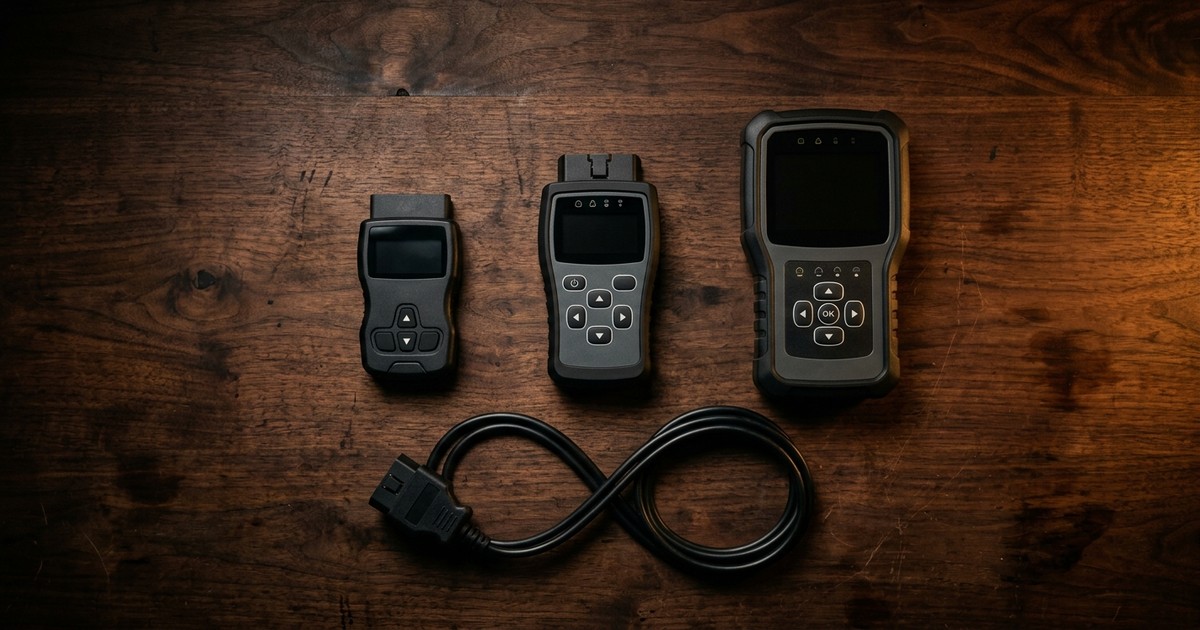
The technician then plugs a professional scan tool (Snap-on Solus Edge, Autel MaxiSys, Launch X-431, or the manufacturer's factory tool) into the OBD-II port. The tool reads stored DTCs, pending DTCs, freeze-frame data (the engine's operating conditions at the moment the fault was detected), and Mode $06 test results (the on-board diagnostic monitor results, which can reveal a marginal component before it sets a code). For a P0171 lean code, the tech notes engine RPM, coolant temperature, vehicle speed, short-term and long-term fuel trim, and load percentage from the freeze frame. A lean code that triggers only at idle points to a vacuum leak; one that triggers at wide-open throttle points to fuel delivery.
Pinpoint testing comes next. For the same P0171, the tech might use a smoke machine to inject mineral-oil smoke into the intake and watch for leaks at the PCV, intake gaskets, vacuum lines, and brake booster hose. If the smoke test is clean, they connect a fuel pressure gauge to verify the pump is delivering rated pressure under load (typically 55–65 psi for port-injected engines). If fuel pressure is fine, they back-probe the MAF sensor signal wire with a multimeter and compare the live grams-per-second reading to the manufacturer's specification at idle (typically 2–7 g/s on a 4-cylinder). Each test rules out a branch of the diagnostic tree. This is the work you're paying $80–$150 an hour for, and it's why a shop diagnosis is worth more than a $20 scanner.
Car Diagnostic Cost: National Averages and What Drives Them
A car diagnostic costs $80–$150 at an independent shop and $120–$200 at a dealership for a basic code-plus-pinpoint diagnosis in 2026. Pricing varies by region (urban shops bill 15–25% higher than rural ones), labor rate (independent shops average $80–$120/hour while dealerships run $130–$200/hour), and complexity. A clear P0420 catalytic converter code with a 5-minute pinpoint test sits at the low end. An intermittent no-start with multiple stored codes and a 2-hour back-probing session sits at the high end. The numbers below come from CarMD's 2026 Vehicle Health Index, RepairPal cost estimates, and Consumer Reports' 2026 scan-tool guide.
| Provider | Diagnostic Fee | Hourly Rate | Notes |
|---|---|---|---|
| AutoZone / O'Reilly / Advance Auto | $0 | n/a | Code read only, no pinpoint testing |
| Pep Boys (most locations) | $0 | n/a | Code read only |
| Independent mechanic | $80–$150 | $80–$120 | Waived at most shops if you authorize the repair |
| Chain shop (Firestone, Midas, Meineke) | $99–$150 | $100–$140 | Diagnostic fee usually not refunded |
| Mobile mechanic (YourMechanic, Wrench) | $90–$140 | $90–$130 | They drive to you; fee per hour same as shop |
| Dealership | $120–$200 | $130–$200 | Factory scan tool, TSB and recall lookup |
| Specialty diesel or European shop | $150–$300 | $140–$220 | Required for advanced module diagnostics |
Worked example: a 2019 Honda CR-V comes in with a check engine light and a rough idle. Independent shop labor rate is $110/hour. The tech retrieves P0301 (cylinder 1 misfire) and P0420 (catalyst efficiency below threshold). Freeze-frame data shows the misfire only occurs at idle, 600 RPM, coolant temp 195°F. The tech pulls cylinder 1's coil and spark plug; the plug shows oil fouling. A compression test on cylinder 1 reads 145 psi vs. 175 psi on the other three cylinders. Diagnosis: failed valve stem seal allowing oil into the cylinder. Total diagnostic time: 1.2 hours. Diagnostic fee: $132. If the customer authorizes the $1,200 valve stem seal repair, the $132 is rolled into the total. If they decline, they pay $132 and have a complete diagnosis to take elsewhere.
Dealership diagnostics cost more for two specific reasons. Factory scan tools (Honda HDS, Ford IDS, BMW ISTA) can read modules that aftermarket scanners cannot: heated steering wheel control modules, adaptive cruise radar, ADAS camera calibrations. The dealership also has access to manufacturer technical service bulletins (TSBs) and recall information by VIN. A 2022 Subaru Outback with a CVT shudder code, for example, might already be covered under a TSB or warranty extension, and the dealership will catch that where an independent might not. Pinion's VIN lookup pulls open NHTSA recalls before you authorize any repair, which can short-circuit a diagnostic when the fault is already on a recall list.
How to Do Basic Car Diagnostics Yourself
You can run a basic diagnostic at home for about $20 in tools. A Bluetooth ELM327 adapter (BAFX Products for Android, $25; Veepeak OBDCheck BLE+ for iPhone, $30) plugs into the OBD-II port and pairs with your phone over Bluetooth. Pair it with Torque Pro ($4.99 on Android) or OBD Fusion ($9.99 on iOS and Android) and you can read codes, view live sensor data, capture freeze-frame snapshots, and clear the check engine light. This setup handles the 60% of fault codes that fall into emissions, sensor, and basic powertrain categories: P0171 lean codes, P0420 catalyst codes, P0300-series misfires, EVAP leaks, oxygen sensor faults. See Best OBD2 Scanners for DIY Car Diagnostics (2026) for a direct comparison of the top scanners and apps.
The diagnostic process for a home mechanic:
-
Read the stored and pending codes. Pending codes flag a developing fault that has not yet illuminated the check engine light. Capture them all.
-
Pull the freeze-frame data for each code. Freeze frame is the snapshot of engine RPM, coolant temp, vehicle speed, fuel trim, and load at the instant the fault triggered. A lean code at 600 RPM and 195°F points to a vacuum leak. The same code at 4500 RPM and wide-open throttle points to fuel delivery.
-
Watch live data with the engine running. Short-term fuel trim (STFT) and long-term fuel trim (LTFT) tell you how hard the ECU is working to correct the air-fuel ratio. Trims consistently above +10% mean the engine is running lean; below −10% means rich. A MAF sensor reading 2–7 g/s at idle is normal on a 4-cylinder; readings outside that range suggest a dirty or failing MAF.
-
Cross-check against the freeze frame. If the freeze-frame data is consistent with what you're seeing now, the fault is active. If the live data looks fine but a stored code says otherwise, the fault is intermittent. Note when it happens (cold starts, highway speeds, after refueling) and decide whether to fix it now or wait for it to repeat.
-
Decide your repair path. Simple, single-cause codes (gas cap, dirty MAF sensor, vacuum hose) are good DIY repairs. Multi-cause codes (P0171, P0420), no-start conditions, and anything involving ABS, airbag, or transmission modules belong at a shop.
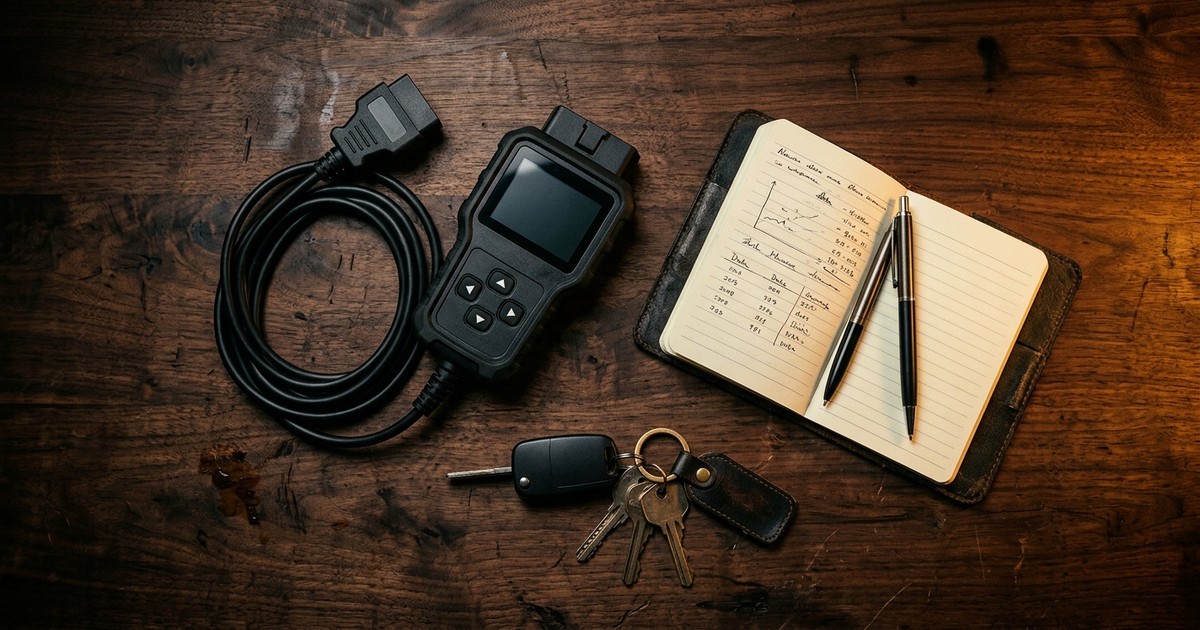
The minimum home diagnostic kit costs about $27: a BAFX Products Bluetooth ELM327 adapter ($22) plus Torque Pro ($4.99). For iPhone, swap in the Veepeak OBDCheck BLE+ ($30) and OBD Fusion ($9.99). With this setup you can pull stored and pending DTCs, view freeze-frame data, watch live fuel trim and oxygen sensor voltage, and clear codes; the same data a $300 handheld pulls. Do not clear codes immediately before a state emissions test; clearing wipes OBD-II readiness monitors, which take 50–200 miles of mixed driving to reset.
For check engine light scenarios specifically, the Check Engine Light: What It Means and What to Do guide breaks down the most common codes by frequency and repair cost.
What DIY Scanners Can't Do
Generic OBD2 scanners read powertrain (P-codes) only. They cannot read ABS, airbag (SRS), transmission control module, or body control module codes on most vehicles. The OBD-II standard (SAE J1979) defines mandatory powertrain diagnostics; all other modules use manufacturer-specific protocols that require enhanced scanners. A flashing ABS light with no check engine light will not show up on a $20 ELM327 dongle on most cars. Reading those codes typically requires a $100+ scanner with brand-specific support, or a brand-specific app like FORScan ($10 for the Extended License, Ford/Mazda/Lincoln only), BimmerLink ($30, BMW only), or VAG-COM/VCDS ($229+, VW/Audi only).
Bi-directional control (actively commanding components from the scanner) also requires a higher-tier tool. This is what lets a technician cycle the fuel pump on command, retract a brake caliper piston for pad replacement on a vehicle with an electric parking brake, bleed ABS modulators, or run an injector balance test. The Autel MaxiCOM MK808 ($350) is the cheapest scanner with broad bi-directional support across most brands. Without bi-directional control, you can read and clear codes but not actively test components.
Module coding and key programming (adding a new key fob, registering a new battery to a BMW's intelligent battery sensor, calibrating a steering angle sensor after an alignment) require manufacturer-level tools and security access. These are not DIY tasks on a $20 dongle. Most independent shops outsource them to a dealer or a specialist with a J2534 pass-thru programmer.
When to DIY vs. Take It to a Shop
Run the diagnostic yourself when the code is well-defined, the freeze-frame data is consistent, and the repair is mechanically simple. Take it to a shop when the symptoms don't match the codes, when multiple unrelated codes are stored, when ABS/airbag/transmission lights are involved, or when intermittent problems require specialty equipment (smoke machines, scope readings, fuel pressure gauges) you don't own. The point of a DIY scan is not to replace your mechanic. It is to walk into the shop knowing what's going on so you can have an informed conversation and avoid paying for a diagnosis you have already done.
Decision rule: If you have a single powertrain code, consistent freeze-frame data, and the fix is a part you can reach with basic hand tools, handle it yourself. If the code involves ABS, airbag, or transmission modules, or if you see three or more unrelated codes at once, take the car and your freeze-frame screenshots to a shop.
DIY scan first, repair yourself if:
- Check engine light only, car drives normally
- Single P-code, freeze-frame data is consistent
- Code points to a simple part: gas cap, MAF sensor cleaning, air filter, vacuum hose, spark plugs, ignition coil
- Live fuel trim and sensor data line up with the code
DIY scan first, take to a shop with the data if:
- Multiple codes across systems (powertrain + EVAP + O2)
- Intermittent code that won't reproduce on demand
- Code conflicts with the symptoms you're feeling
- You want a second opinion on a shop's quote
Skip DIY, go straight to a shop if:
- ABS, airbag, traction control, or stability control light on
- Transmission warning or slipping
- Flashing check engine light (active misfire damaging the catalytic converter)
- No-start condition with no codes set
- Crash or collision related faults
Three diagnostic results justify driving straight to a shop without bothering with a DIY scan: a flashing check engine light (active misfire damaging the catalytic converter, up to $1,300 in damage per 100 miles), any ABS or airbag warning (most generic dongles cannot read these modules), and any transmission warning. For everything else, pulling the code yourself first saves the $80–$150 diagnostic fee or at least gives you the data to challenge an inflated shop quote. Bring the freeze-frame screenshot, not just the code.
Diagnostics for Specific Symptoms Without a Check Engine Light
Not every drivability problem sets a check engine light. The OBD-II system only monitors emissions-related faults; mechanical problems (worn bushings, failing wheel bearings, transmission valve body issues), electrical problems below the threshold the ECU monitors, and most comfort and convenience faults (power windows, seat heaters, infotainment) don't trigger the MIL. A shop diagnostic for these symptoms looks more like detective work and less like code retrieval.
Common no-code diagnostics:
- Wheel bearing hum that changes with cornering: road test at varying speeds while loading the suspension left and right. A bad bearing gets quieter when the load shifts off it.
- Brake pulsation when stopping: measure rotor thickness variation with a micrometer; over 0.001" runout typically causes pulsation. See brake pad replacement for service intervals and rotor specs.
- Steering pull or uneven tire wear: alignment check on a four-wheel rack with toe, camber, and caster measurements compared to spec. Covered in the wheel alignment guide.
- Engine rattle on cold start: listen with a stethoscope on the cam cover, check VVT solenoid operation, verify oil pressure with a mechanical gauge. In 7 out of 10 cases this points to a worn timing belt or chain tensioner.
- Transmission slip without a code: review fluid color and level, perform a line pressure test, scan the TCM with a brand-specific scanner. The transmission repair cost guide covers what to expect.
- Intermittent stalling at idle: monitor live idle air control valve duty cycle, check for vacuum leaks with a smoke test, verify fuel pressure decay over time. Worn spark plugs are a common contributor.
A shop diagnostic for any of these typically runs $100–$250 because the work is in the test, not the code retrieval. Bring as much information as you can: when does the symptom occur, what does it feel/sound/smell like, how long has it been happening, and what changed before it started. A complete customer interview cuts diagnostic time substantially.
The app's NHTSA recall check by VIN is worth running before any expensive no-code diagnostic, because specific symptoms like CVT shudder on certain Nissans, ignition coil failures on early Ford Focus 1.0L EcoBoosts, and takata-era airbag faults are open campaigns that the manufacturer must fix for free.
Frequently Asked Questions
How much does a car diagnostic test cost?
A code read is free at AutoZone, O'Reilly, or Advance Auto Parts. A full diagnostic at an independent shop costs $80–$150 and includes the code read plus pinpoint testing (voltage checks, component testing, live data analysis) to identify the root cause. Dealerships charge $120–$200. Most independent shops waive the diagnostic fee if you authorize the repair with them, so ask before paying upfront.
Can I diagnose my car myself?
Yes, for basic diagnostics. A $15–$25 Bluetooth OBD2 scanner with the Torque Pro or OBD Fusion app reads trouble codes, displays live sensor data, and captures freeze-frame snapshots. This handles roughly 60% of common issues: check engine light codes, sensor faults, and emissions problems. For ABS, airbag, transmission, and body control module codes you need a shop with manufacturer-specific diagnostic software like Autel MaxiSys, Snap-on Solus, or the OEM factory tool.
What's the difference between a code read and a diagnostic?
A code read pulls the trouble code stored by your car's powertrain control module; it tells you the symptom (P0171 system too lean, P0420 catalyst efficiency below threshold). A diagnostic uses the code as a starting point and runs pinpoint tests (voltage, resistance, vacuum, fuel pressure, live sensor data) to identify which component actually failed. The code says where to look; the diagnostic tells you what to fix. A P0171, for example, can be a $5 vacuum hose or an $800 fuel pump.
Where can I get a free car diagnostic near me?
AutoZone, O'Reilly Auto Parts, and Advance Auto Parts offer free OBD-II code reads at most U.S. locations during business hours, no appointment needed. Pep Boys and select Firestone locations also offer free code reads. These services only retrieve trouble codes and do not include pinpoint testing or live data analysis. Most independent shops waive the diagnostic fee when you commit to the repair, which is effectively a free diagnosis if the repair costs more than $150.
How long does a car diagnostic test take?
A parts-store code read takes 2–5 minutes. A basic shop diagnostic (code read plus visual inspection and live data review) runs 30–60 minutes. Complex intermittent faults can require 2–4 hours of bench testing, smoke testing, and back-probing connectors. Most shops bill diagnostic time in 30-minute or 1-hour blocks at $80–$150 per hour.
What car diagnostic app should I use?
Torque Pro ($4.99 on Android) and OBD Fusion ($9.99 on iOS/Android) are the two best paid OBD2 apps; both work with any ELM327 Bluetooth adapter and display live sensor data, freeze-frame analysis, and customizable dashboards. Car Scanner ELM OBD2 is the best free option on both platforms. None of these read ABS, airbag, or transmission codes without a manufacturer-specific scanner like BimmerLink ($30) for BMW or FORScan ($10) for Ford.
Frequently Asked Questions
Vlad Kuzin
Developer of Pinion. Writes about car maintenance to help people save money and stay safe on the road.